Before setting out this section on the Hamilton Family CDHS must acknowledge the immense amount of research work that Beverley Isdale has done to tell the story of the extensive Hamilton family. In 2001 Beverley published "All Blessings Flow: The Hamiltons of Chermside". This biographical work tells the full story of this pioneering family which contributed much to the development of Chermside. Beverley was the first archivist of CDHS and knows more about the district than anybody else.
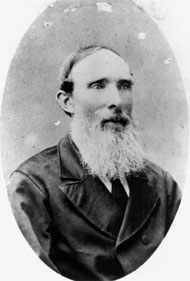
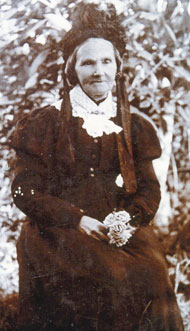
Andrew Hamilton, a carpenter, joiner and wheelwright by trade, married Margaret Hall on 24/4/1848 at Devonport, England. They had six children, all born in England, but two died in infancy and the eldest, James, was killed in an accident before they migrated. The family arrived in Brisbane in 1866 and moved to Dead Man's Gully in 1869 where Andrew had bought a 20 acre block to farm but quickly found that working at his trade would provide a better living. He began by building a dray and making the wheels himself but soon he was making both for local farmers.
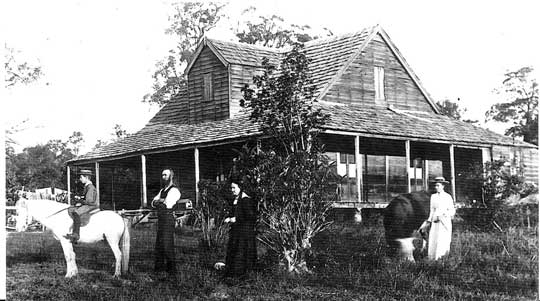
He bought another block of land fronting Gympie Road and set up his workshop; the site is now occupied by QML Pathology. The business flourished and he employed a blacksmith calling the business Fivemiletown Forge after Margaret's native village in Northern Ireland. Other relatives followed bringing their families with them and some worked in the business.
Because of the chronic shortage of skilled tradesmen in the colony their wages rose above what they would have been paid in England. A skilled carpenter-joiner, working the usual 48 hour week, could earn 6/- a day in Queensland, but when Judge Lutwyche was building his mansion, Andrew Hamilton was earning 14/- a day fitting out the internal woodwork, because he was able to do a very high standard of work. He was a universal type of worker in that he was also a skilled wheelwright, acquired the skills to run a blacksmith business, and was appointed postal receiving officer in 1884 and the first non-official postmaster at Downfall Creek in 1886. The post office was in a room off his forge on Gympie Road and he received a salary of 12 pounds per annum (approximately $1,900 in 2024 values); in 1889 James Hamilton, son-in-law of Andrew, became the non-official postmaster.
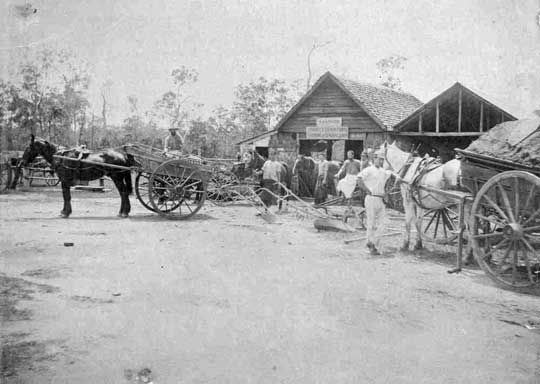
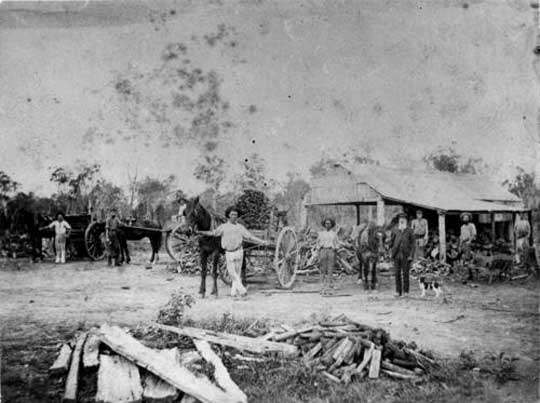
The large shed on the right is Andrew's carriage building workshop. The small skillion on the left became the first post office in Downfall Creek in 1886 when Andrew was appointed the first official postmaster in the district. The Fivemiletown Forge would have been the first blacksmith shop in Downfall Creek and would have been opened when he bought the second block of land on Gympie road in about 1875. The figures are interesting; the blacksmith is wearing the leather apron and holding a horse shoe, the figure in the white carpenter's apron could be Thomas, but who is the third one?
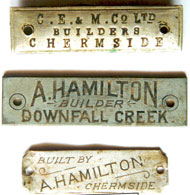
Builder's plates were attached to the finished product such as a sulky or a wagon. It was a simple form of advertising similar to brand names on cars today. The top one is for the Chermside Engineering & Manufacturing Company Limited. This was the firm that bought out the family business in 1913. The second plate belonged to Andrew as he worked in Downfall Creek but the third one could not have been Andrew. He died in 1897 and the name Chermside was not used till 1903. Possibly the business remained in his name!
In about 1873 when Andrew got some spare time, he began to build the family home, Burnie Brae, overlooking the village, but being a very busy man the house was still unfinished when he died in 1897 and the attics were never completed; they were used for storage. Burnie Brae was built from local timber pit-sawn on site and logs of cedar bought from passing bullock wagons. The roof was shingles which were 762mm (2ft 6ins) long and up to 254mm (10ins) wide. The outside walls were drop slab with 10 inch wide slabs dressed as chamfer boards dropped between 100mm X 100mm (4in x 4in) studs. In 1947 the house and land were resumed by the Public Curator for public housing and the family received compensation of 1,350 pounds (approximately $113,000 in 2024 values). Subsequently the house was demolished in 1952 and the approximately 10 acre block became Annand Park owned by the Brisbane City Council. The name was changed to Burnie Brae Park in 1997.
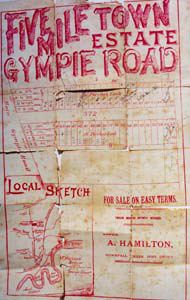
Probably the first housing estate subdivision in Downfall Creek was the Fivemiletown Estate on Andrew Hamilton's land on the east side of Gympie Road near Hamilton Road. Like other early settlers, Andrew Hamilton had taken up an area for a small farm but found it more profitable to sell the land in house blocks than farm it. This venture marked the Hamilton family's involvement with land speculation. They bought land in other places, sometimes built houses thereon, renting and selling them. He offered 50 blocks of between 16 and 22 perches, on easy terms and interest free for 12 months. He named the estate after Margaret's native village in Ireland. The date is unknown but it was possibly as early as 1886 which is written on the original poster and, since it names A. Hamilton as the vendor and his office is the Downfall Creek Post Office which he vacated in 1899, then it could have been before that date.
Thomas left school at the age of 12 and began to learn the trades of carpenter, wheelwright and carriage builder from his father Andrew. In 1884 he selected 160 acres on Payne's Creek (Woombye) and developed a farm from the bush and while there married his cousin Margaret Jane (MJ) in 1887. They raised seven children all of whom survived. But like his father he was more a tradesman than farmer and moved back to Downfall Creek in 1890 where he started the Albion and Lutwyche Fuel Depot selling fire wood to various brick yards as well as to domestic users. He installed a steam engine to drive the circular saws which were used to cut the wood to specific sizes; he also made coke.
When Andrew died in 1897, Thomas took over the running of the family business on Gympie Road. Trade was flourishing and they built standard vehicles such as drays, sulkies, wagons, spring carts as well as vehicles for specific purposes such as grocer's cart, milk cart, flat top cart or lorry, German wagon or fruit wagon. If someone wanted a special cart or carriage, as long as they had a photo or a magazine picture or drew a sketch of it, then Thomas would build the vehicle including accessories such as rubber tyres and the best leather upholstery. This was the time when the vehicles were individually built by local tradesmen working manually so that the local industry was immensely flexible. The hours were long, the work hard and often heavy, there was little in the way of machinery and the workers had to be highly skilled.However, large scale production of standard vehicles was already happening. Cobb & Co had been doing this with their coaches almost as long as they had been in Australia, while mass production was flourishing in USA and Europe. So instead of making all the parts for a vehicle Thomas had to buy imported mass produced parts as they were cheaper.
Stan Eddowes notes that Thomas was the foundation choir master of the Downfall Creek, later Chermside Methodist Church, aided by the only musical instrument they had, Thomas' tuning fork. Thomas formed the choir in the 1870s before they had any instruments. He was still the conductor of the choir and orchestra in 1939. The photo below shows him in old age with his slightly twisted face the result of a bout with Bell's Paralaysis in the early 1920s. This was the year after his beloved MJ died. He went on conducting until he was in his eighties. Thomas was a self taught violinist, made his own violin, read music, composed pieces of choral and musical work and organised the Downfall Creek Musical Society.
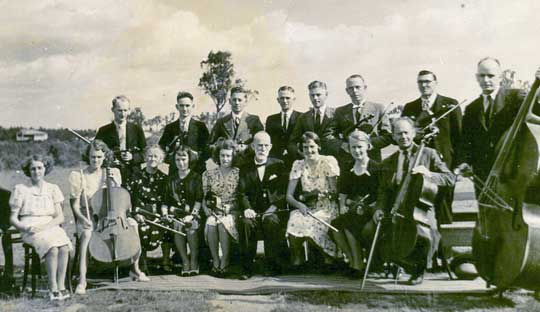
Thomas kept a diary in which he diligently recorded his daily business and activities over a period of sixty years from 1890 to 1951. Along with many photographs, letters, musical scores the diary forms the basis of his personal archive and a day to day description of much of the history of the local area. When the Federation Referendum was held in 1899 he was one of only seven voters in Downfall Creek in favour of establishing the Commonwealth. As a carriage maker he may not have feared competition from Sydney and Melbourne but other local manufacturers did. When the World War I broke out in 1914 many local men enlisted, among them was Thomas Andrew Edward (Eddie) Hamilton, son of Margaret and Thomas. The Diary record of Eddie's return from the war in 1919 is especially detailed and reflects the relief the family experienced to have him back "in one piece". You can read about Thomas Hamilton's diary here.
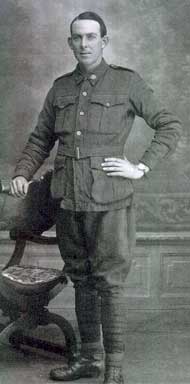
Hugh Hamilton (1890-1971) married May Carseldine (1889-1974) on 16 February 1915. They had three children.Hugh worked for his father, Thomas, from the age of eight, his first job was painting the vehicles in the workshop. Later he had a milk run and worked in Uncle William's blacksmith shop. In the early 1900s motor vehicles were appearing and the Hamiltons saw that they would probably replace the horse drawn vehicles so in 1913, they decided to sell the vehicle building business. Thomas became a director of the new firm, the Chermside Manufacturing Company Ltd, which prospered for some years but by 1919 it was experiencing difficulties.
The company finally went into liquidation in May 1920 and Hugh rented the workshop for a time. In April 1923 he bought the business as he had decided that the future was in motor vehicles and not horse power; he was right and Thomas went and worked for him. The business specialised in building bodies on chassis (steel frame) imported from the UK and USA. "Bodies, canopies, windscreens, toolboxes and seats had to be adjusted to meet requirements for customers whose vehicles delivered milk, bread, fruit, ice and meat to shops and homes." He built many heavy duty vehicles for councils, the first motor horse float in Queensland, bus bodies and converted cars to utilities.
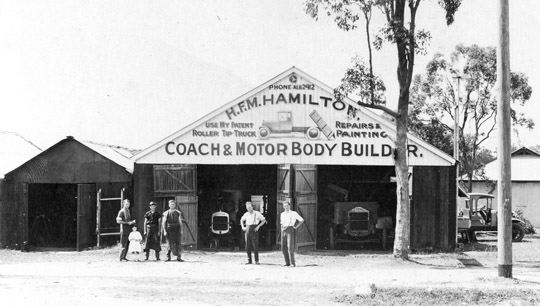
The new building in the photo above was probably erected by the company which Hugh bought. The clutter of carts in the earlier photo above is gone as Gympie Road had become too busy to allow such luxuries. Motor mechanics and panel beaters have replaced the older carriage builders but the carriage painters are still busy. The blacksmith forge on the left is still in operation and a couple of smiths stand near the left of the group wearing their traditional leather aprons.
In 1936 local bus operators, Dave Little and Les Boyce, bought a 1936 Dodge and had the body fitted by Hugh Hamilton with the seats fitted across the bus and the aisle down the centre as they are today. Previous buses had the seats around the sides and back with the passengers facing in towards the centre. In 1938 they bought a "Maple Leaf" and had the body fitted by Hugh Hamilton. These two buses were still in use until Rex Mitchell bought the business in 1945 linking his Sandgate run with the Bald Hills run. By the early 1950s motor vehicles were being mass produced in a very wide variety of brands and models so that a motor body builder would have a much more limited scope than in the pre World War II era. Times were changing, again. In 1951, after three generations, Hugh ended the Hamilton family connection with the firm and sold it to Mr E B McNulty, a bodybuilder of Stafford, who continued to operate it under the Hamilton name at 531 Gympie Road, Kedron. After about 150 years, the business still continues to operate under the Hamilton name. Andrew Hamilton would be quite at home in the workshop after he learned the new skills of 21st Century body working.
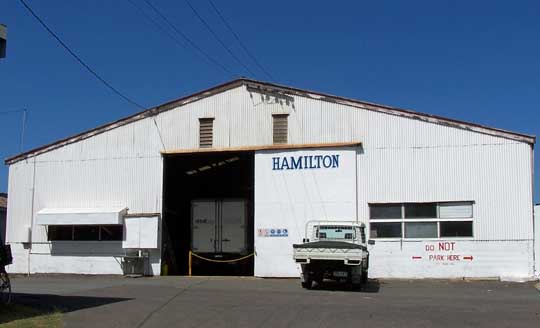
Andrew, the first generation, died "in the shaves" at the age of 71. Thomas, the second generation, went to work with his son Hugh rather than retire. Alex, the third generation, at age 73, used his lifetime skills and time to restore a horse omnibus which he found gradually deteriorating under a mango tree in a friend's backyard. He offered to restore it and give it to the Queensland Museum, and the offer was accepted. It was to remain as a memorial to the skills and dedication of the many workers who built and drove these once "state of the art" transport vehicles. He wanted new generations of Australians to remember how earlier generations moved around. The horse bus is now on show in the Cobb & Co Museum in Toowoomba.
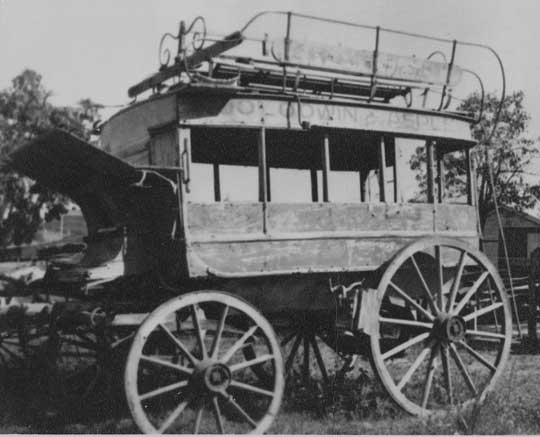
The old horse bus or omnibus as it was called was in a sorry state. Some roof timbers were rotted, the paint was almost all gone, rust was taking its toll, the glass was missing from the windows, the upholstry was rotted.
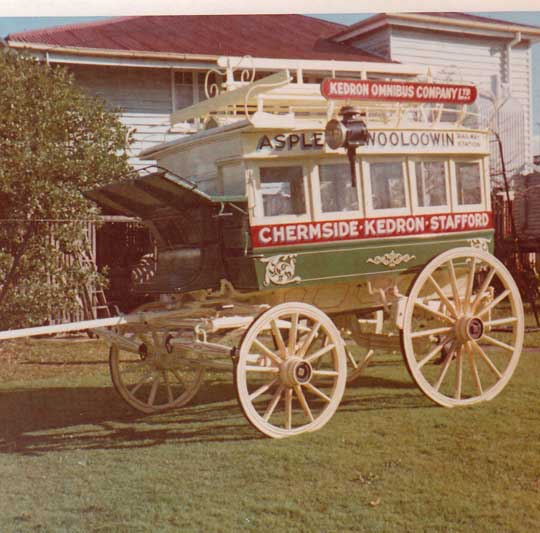
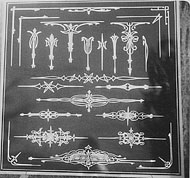
Alex was a carriage painter and detailer. He did the elaborate scroll work shown on the bus by hand, he made the vehicles look great. The work was all done by hand using the materials and methods of past generations long before the age of the Motor Car. After a couple of hundred hours of work Alex finished the job of restoration. He was assisted by a younger man who did the underside of the bus because at 73 Alex was not as young as he used to be.
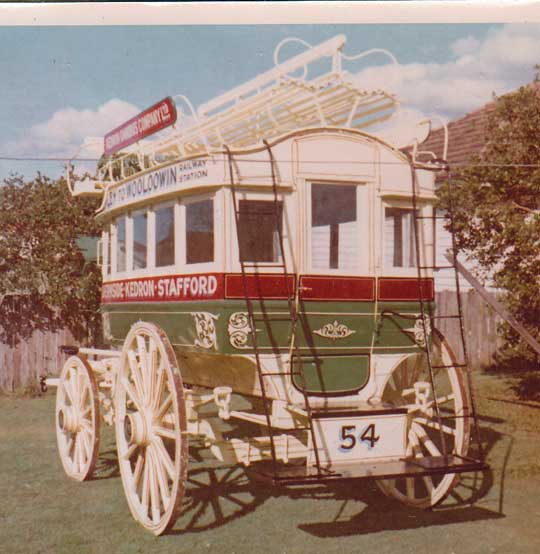
The rear of the restored bus shows the iron ladders that passangers had to climb to get a place on the two roof garden seats. There were no seat belts, so they had to hang on. You needed an umbrella in wet weather. The downstairs passangers entered through the back door.
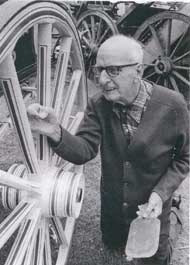
Alex was a skilled carriage painter and linesman. At 73 his hand was steady and he could make his lines straight or curved. He had been doing the job for over 60 years. Examples of his art can be seen on the back and side photos of the restored Omnibus. Alex did not use transfers or stencils. He drew the scrolls, curves, lines, curlicues, the complicated designs by hand. He drew the table below to preserve the old art.
This text was written by Patrick O'Shea in 2010, and was updated by Bradley Scott in 2025.


All content © 2010-2026 Chermside & Districts Historical Society